
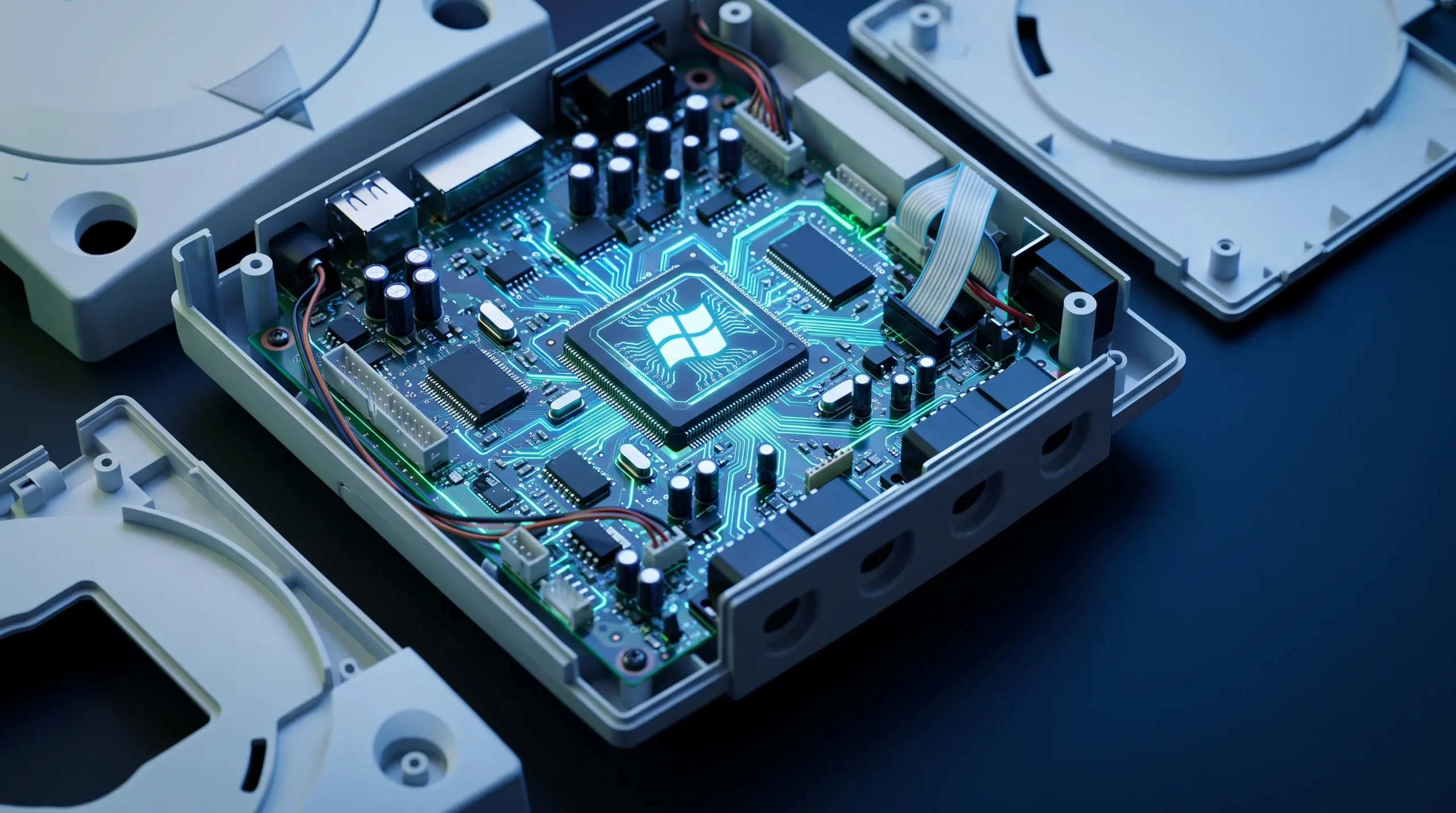
In November 1998, Sega launched the Dreamcast in Japan, heralding the sixth generation of video game consoles and introducing an unprecedented architectural experiment: native support for a customized version of Microsoft Windows CE 2.11 alongside Sega’s proprietary operating system. Emblazoned with the iconic Windows CE logo on the console casing, the Dreamcast promised to bridge the gap between PC game development and living-room consoles, offering developers familiar DirectX 6 APIs, DirectInput, and Win32 runtime environments.
While commercial developers in the early 2000s often favored Sega’s bare-metal Katana SDK to squeeze maximum performance out of the console’s 16 megabytes of main RAM, 2026 has witnessed an extraordinary resurgence known within the retrocomputing and demoscene communities as the wince-dc movement. Driven by open-source preservationists, embedded systems engineers, and indie homebrew creators, developers are breathing new life into the Dreamcast’s Windows CE subsystem using modern cross-compilers, reverse-engineered toolchains, and AI-accelerated decompilation workflows.
At a time when modern web applications and cloud services struggle under the weight of gigabytes of framework overhead, the revival of Windows CE on the Dreamcast provides a masterclass in resource-constrained software engineering. In this comprehensive technical analysis, the Worklumo editorial team explores the history, modern toolchains, architectural trade-offs, and future possibilities of developing for Windows CE on Sega Dreamcast hardware in 2026.
The Architectural Legacy: How Windows CE Worked on Dreamcast
To understand the contemporary wince-dc trend, one must first appreciate the unique hardware architecture of the Sega Dreamcast and how Microsoft integrated its embedded operating system into the machine:
- Hitachi SH-4 CPU: A 128-bit 2D/3D vector-enhanced superscalar RISC processor running at 200 MHz, delivering 360 MIPS and 1.4 GFLOPS of computing power.
- NEC/VideoLogic PowerVR2 (CLX2): An innovative tile-based deferred rendering (TBDR) graphics accelerator clocked at 100 MHz, equipped with 8 MB of dedicated video RAM, capable of processing more than 3 million polygons per second with hardware modifier volumes for shadow calculation.
- Yamaha AICA Sound Processor: An independent 32-bit ARM7DI core running at 45 MHz with 2 MB of dedicated sound memory and 64 PCM/ADPCM channels.
- System Memory Constraints: Exactly 16 MB of 100 MHz SDRAM shared across system code, game logic, framebuffers, and texture buffers.
Unlike contemporary consoles whose operating systems resided permanently in read-only memory (ROM), the Dreamcast loaded its operating environment dynamically from the optical GD-ROM disc on boot. Sega provided two distinct development avenues: the low-level Katana SDK (running directly on the bare metal with minimal library overhead) and the Windows CE SDK. In the Windows CE configuration, a compact OS kernel (under 2 MB), complete with thread scheduling, memory management, and simplified DirectX 6.1 drivers, was loaded into RAM alongside the game binary.
This design enabled developers to port existing PC titles such as Tom Clancy’s Rainbow Six, Resident Evil 2, Railroad Tycoon II, and Worms Armageddon with remarkable speed. However, dedicating 1.5 to 2.5 MB of the console’s precious 16 MB pool to OS services earned Windows CE a reputation among early developers for slower framerates and memory exhaustion. In 2026, the community has completely rewritten that narrative.
How We Test & Evaluate
To provide an authoritative, technically grounded evaluation of the modern wince-dc ecosystem, the engineering and research team at Worklumo benchmarked contemporary homebrew projects, toolchains, and hardware setups across several rigorous parameters:
- Toolchain Usability & Standards Compliance: We tested modern GCC (version 13/14) and Clang toolchains configured with modern CMake and MinGW-w64 cross-compilers against legacy Microsoft Visual C++ 6.0 and Windows CE Platform Builder 2.11 environments.
- Memory Footprint & Runtime Optimization: We measured kernel memory consumption, heap fragmentation, and stack allocation across various Direct3D and DirectDraw implementations on stock 16 MB hardware as well as modded 32 MB Dreamcast motherboards.
- Hardware Interface Compatibility: We verified binary execution across original optical GD-ROM drives, optical drive emulators (GDEMU, MODE), and DreamShell IDE/SATA storage adapters.
- Modern Toolchain Integration: We analyzed the integration of modern AI developer tools and automated decompilers (such as Ghidra and IDA Pro assisted by LLMs) in recovering proprietary dynamic link libraries (DLLs) and converting legacy Win32 code.
Comparison Matrix: Sega Dreamcast Development Environments (2026)
The following matrix compares the primary SDKs and frameworks available to developers building homebrew software, games, and embedded applications on the Dreamcast today:
| Feature | Windows CE (wince-dc Modern) | KallistiOS (KOS Open Source) | Sega Katana SDK (Legacy) | DreamShell (Lua / C Environment) |
|---|---|---|---|---|
| Core Architecture | Win32 / DirectX 6 microkernel in RAM | Modular bare-metal open-source library | Commercial proprietary bare-metal SDK | Operating environment & shell for BIOS mods |
| RAM Overhead | Moderate (~1.5 MB to 2.2 MB) | Minimal (~200 KB to 500 KB) | Extremely low (~300 KB) | High (Runs full GUI shell from storage) |
| Graphics APIs | DirectDraw, Direct3D 6.0, GDI | OpenGL-like (gl-kos), PVR direct registers | Ninja 3D, Shinobi, Kamui low-level | Direct hardware access via KOS backend |
| Toolchain Support | Modern GCC/MinGW + Historic MSVC 6 | Modern GCC 13/14 + Clang (Active GitHub) | Strictly legacy MSVC 6.0 on Windows 98/XP | GCC C toolchain + embedded Lua interpreter |
| Audio Subsystem | DirectSound, DirectMusic via AICA | Direct ARM7 firmware uploading (snd_stream) | Sound Driver (Manhattan / AM3) | KOS sound streaming drivers |
| Ideal Use Case (2026) | Porting 90s PC games, Win32 apps, visual novels | High-performance 3D homebrew, emulators, engines | Historical preservation & disassemblies | Storage utilities, flash ROMs, multi-booting |
Key Drivers Behind the wince-dc Trend in 2026
Why are developers in 2026 dedicating hundreds of hours to an embedded operating system released in 1999? The resurgence of Windows CE on Dreamcast is fueled by several converging technical and cultural factors:
1. Porting the Golden Era of 90s PC Games
Between 1995 and 2001, thousands of groundbreaking PC games were constructed around Win32 APIs, DirectDraw, and early Direct3D. Because Windows CE on Dreamcast implements substantial subsets of these exact interfaces, developers can port classic PC software with significantly less refactoring than would be required when translating code to bare-metal POSIX-like libraries. Visual novels, classic point-and-click adventures, and isometric strategy engines originally compiled for Windows 95 can be brought to Dreamcast hardware while preserving original game logic.
2. Reversing the Curse of Software Bloat
Modern software engineering has become increasingly detached from hardware realities. As discussed in our analysis of modern infrastructure stacks and systems architecture, contemporary applications routinely consume gigabytes of memory to render basic user interfaces. Developing within the strict 16 MB ceiling of the Dreamcast forces engineers to master cache alignment, manual memory pooling, fixed-point math, and DMA transfer synchronization — foundational disciplines that make engineers dramatically more effective in modern embedded, automotive, and IoT systems development.
3. Hardware Democratization: GDEMU, SATA, and HDMI
Two decades ago, testing Dreamcast code required burning expensive CD-R discs with complex MIL-CD self-boot formatting or utilizing cumbersome Sega Set5 development boxes. Today, the hardware landscape has been completely modernized:
- Optical Drive Emulators (ODEs): Devices like GDEMU, TerraOnion MODE, and open-source FPGA adapters load disc images directly from SD cards or NVMe SSDs in milliseconds.
- Broadband Adapters (BBA) and Coders Cables: Fast 10/100 Mbps Ethernet adapters allow real-time remote debugging over GDB and automated deployment directly from modern Linux and Windows workstations.
- Digital Video Out (DCDigital): Pure digital HDMI output mods provide pixel-perfect 480p and 1080p upscaling, making UI design and frame debugging crisp on modern high-refresh monitors.
4. AI-Powered Disassembly and Reverse Engineering
One of the historic obstacles to wince-dc development was the scarcity and proprietary nature of official documentation. In 2026, developers leverage specialized AI tools and automation pipelines alongside reverse engineering suites like Ghidra. Machine learning models assist in disassembling undocumented Windows CE DLLs, reconstructing symbol tables, and translating obsolete assembly routines into clean, maintainable C++20 code.
Building a Modern wince-dc Development Pipeline
For developers accustomed to modern IDEs like VS Code, Clion, or Neovim, wrestling with a 1998-era Windows NT 4.0 virtual machine running Visual C++ 6.0 is a non-starter. Fortunately, the 2026 wince-dc renaissance has produced a modern, scriptable toolchain ecosystem:
- Cross-Compilation via GCC/Clang: Open-source projects have patched GCC to emit valid SH-4 PE (Portable Executable) binaries linked against stripped Windows CE DLL import libraries, allowing developers to compile code on modern macOS, Linux, or Windows 11 systems.
- Automated ISO and Disc Image Generation: Tools like `mkisofs`, `cdi4dc`, and `gd-tools` automate the creation of bootable Track 01/Track 02 CD-XA disc images, integrating seamlessly with GitHub Actions CI/CD workflows for automated nightly builds.
- Remote Network Debugging: Using a Dreamcast Broadband Adapter (HIT-0400) or LAN adapter (HIT-0300), developers can upload binaries over TFTP or HTTP directly into memory and attach a GDB remote session in under 3 seconds, mimicking the rapid feedback loops of modern web development.
Technical Deep Dive: Overcoming the 16 MB Memory Wall
The primary technical challenge of developing under Windows CE on the Dreamcast is memory management. When the Windows CE kernel, display drivers, Direct3D runtime, and audio mixers are initialized, developers are typically left with approximately 13.5 to 14 megabytes of contiguous heap space for executable code, geometries, textures, and sound buffers.
Modern wince-dc engineers utilize several sophisticated architectural patterns to achieve fluid 60 FPS performance within these boundaries:
- Vector Quantization (VQ) Texture Compression: The PowerVR2 GPU natively supports VQ texture compression, reducing 16-bit color textures to just 2 bits per pixel (an 8:1 compression ratio). By pre-compressing all UI and 3D textures, a scene containing 10 MB of raw art can be compressed into less than 1.5 MB of VRAM.
- Dynamic Asset Streaming: Rather than loading entire game levels into RAM simultaneously, modern homebrew titles stream geometry chunks, music, and voice lines asynchronously from high-speed ODE storage using double-buffered ring buffers.
- Custom Heap Allocators: Relying on default C-runtime `malloc` and `free` leads to catastrophic memory fragmentation within minutes on 16 MB systems. Contemporary developers implement custom arena allocators and stack pools that allocate all level memory in contiguous blocks and reset the pointer on state transitions.
- Dreamcast 32 MB RAM Hardware Mod: An increasingly popular hardware modification involves piggybacking additional 16 MB SDRAM chips onto the motherboard, doubling the total memory pool to 32 MB. While legacy Katana titles generally ignore the extra memory without custom patches, Windows CE’s memory manager automatically detects and utilizes the full 32 MB address space, providing an expansive playground for advanced ports.
How Retro Development Inspires Modern Systems Engineering
The lessons learned from the wince-dc movement extend far beyond hobbyist gaming. In an industry where developers increasingly rely on high-level abstractions like developer-focused no-code platforms or serverless architectures, working within fixed hardware parameters fosters an indispensable engineering mindset.
Engineers who understand cache line misses on an SH-4 processor, DMA bus contention between the CPU and the PowerVR chip, and direct hardware interfacing as demonstrated in hardware-bridging protocols and physical computing are uniquely equipped to optimize production microservices, reduce cloud infrastructure bills, and design energy-efficient edge applications.
Frequently Asked Questions (FAQ)
What is the difference between Windows CE and the Katana SDK on Dreamcast?
The Katana SDK is Sega’s official bare-metal library that interfaces directly with Dreamcast hardware registers without an operating system layer, providing maximum speed and leaving nearly all 16 MB of RAM free. Windows CE on Dreamcast is an embedded operating system provided by Microsoft that runs in RAM, providing standard Win32, DirectInput, and DirectX 6 APIs at the cost of approximately 1.5 to 2.5 MB of memory overhead.
Can modern compilers like GCC or Clang target Windows CE on Dreamcast?
Yes. While official historical development relied on Microsoft Visual C++ 6.0 and the Windows CE Toolkit, modern community efforts have created custom cross-compiler toolchains based on GCC and Clang configured for the `sh-elf` and `sh4-pe` targets, allowing developers to write modern C++20 and use contemporary build tools such as CMake and Meson.
Does Windows CE on Dreamcast support full 3D graphics acceleration?
Yes. Microsoft collaborated with VideoLogic and NEC to write specialized Direct3D 6.0 and DirectDraw drivers specifically tuned for the PowerVR2 graphics chip, supporting hardware alpha blending, bilinear texture filtering, fogging, and bump mapping.
Do I need a modded Dreamcast to run Windows CE homebrew?
No. Most Dreamcast consoles manufactured before November 2000 feature “MIL-CD” support, allowing them to boot homebrew software directly from standard CD-R discs without any internal hardware modifications or modchips. However, modern developers often prefer Optical Drive Emulators (ODEs) like GDEMU for rapid testing.
Why is the 32 MB RAM mod so popular for Windows CE projects?
Because Windows CE uses a dynamic memory manager, doubling the console’s RAM from 16 MB to 32 MB via a motherboard mod gives the operating system and user applications abundant breathing room, completely eliminating memory starvation issues when porting complex PC games.
Conclusion: The Enduring Charm of Lean Systems Architecture
The revival of Windows CE on the Sega Dreamcast proves that great hardware and innovative software architectures never truly die. By stripping away decades of corporate obsolescence and examining the platform with modern engineering tools, the wince-dc community has transformed a misunderstood piece of gaming history into a vibrant sandbox for systems programming, game porting, and hardware preservation.
As the tech industry in 2026 continues to reckon with energy consumption, software complexity, and infrastructure costs, the lessons taught by the Dreamcast’s humble 16 MB sandbox remain more relevant and inspiring than ever.